GuidelyPro vs AI Chatbots: Why Structured Guided Selling Outperforms Conversational Bots for E-Commerce
Compare GuidelyPro.AI structured guided selling against conversational AI chatbots for e-commerce. Discover why visual quizzes drive higher conversion rates.
Technology writer, e-commerce strategist, and enterprise software reviewer at AfricaDeep.
Published: 2 October 2026
Updated: 10 October 2026
GuidelyPro vs AI Chatbots: Why Structured Guided Selling Outperforms Conversational Bots for E-Commerce
Affiliate Disclosure: This detailed comparative guide includes official affiliate referral links. When you evaluate or adopt software solutions featured in our research—including [GuidelyPro.AI](https://guidelypro.pxf.io/OYJmQz)—AfricaDeep.com may receive an affiliate commission at no extra cost to you. Our technology assessments are conducted independently based on empirical e-commerce conversion data and UX research.
---
In the wake of the generative AI boom, e-commerce managers, marketing directors, and store owners have been bombarded with pitches urging them to deploy conversational AI chatbots on their digital storefronts. The promise sounds captivating: install a ChatGPT-style conversational assistant in the corner of your store, let customers ask anything they want in natural language, and watch the bot guide them effortlessly to checkout.
Yet when merchants review actual session recordings and conversion analytics from conversational chatbots, reality paints a very different picture.
Shoppers on mobile devices do not want to type lengthy paragraphs into tiny floating chat widgets. Unstructured chat dialogues frequently suffer from AI hallucinations, inventory inaccuracies, slow response latencies, and high abandonment rates. Most critically, conversational chatbots lack the visual clarity, speed, and deliberate psychological momentum required to close digital sales.
This is precisely why structured guided selling platforms like GuidelyPro.AI consistently outperform conversational AI chatbots in driving actual e-commerce transactions.
In this comprehensive comparative analysis, we examine the fundamental psychological, technical, and commercial differences between open-ended conversational chatbots and structured guided selling wizards—and why visual product finders deliver 3x to 5x higher conversion rates for online retailers.
---
The Core Conflict: Open-Ended Typing vs. Visual Recognition
To understand why chatbots struggle in transactional e-commerce, one must look at human cognitive psychology during online shopping.
In cognitive science, recognition memory is vastly faster and requires far less mental effort than recall memory: - Recall Memory (Chatbots): Forces the user to generate questions from scratch, formulate sentences, and type them into a text field ("What type of moisturizers do you have for someone with combination skin and redness?"). - Recognition Memory (Guided Selling): Presents the user with visual, tap-friendly choices ("Select your skin type: [Dry] [Oily] [Combination] [Sensitive]"). The user simply recognizes their situation and taps a button in 0.5 seconds.
Cognitive Effort Comparison:

Conversational AI Chatbot:
User arrives ➔ Sees floating widget ➔ Must think of question ➔ Must type on mobile keyboard ➔ Waits 3-5s for LLM response ➔ Reads wall of text ➔ High Fatigue ➔ High Abandonment

Structured Guided Selling (GuidelyPro.AI):
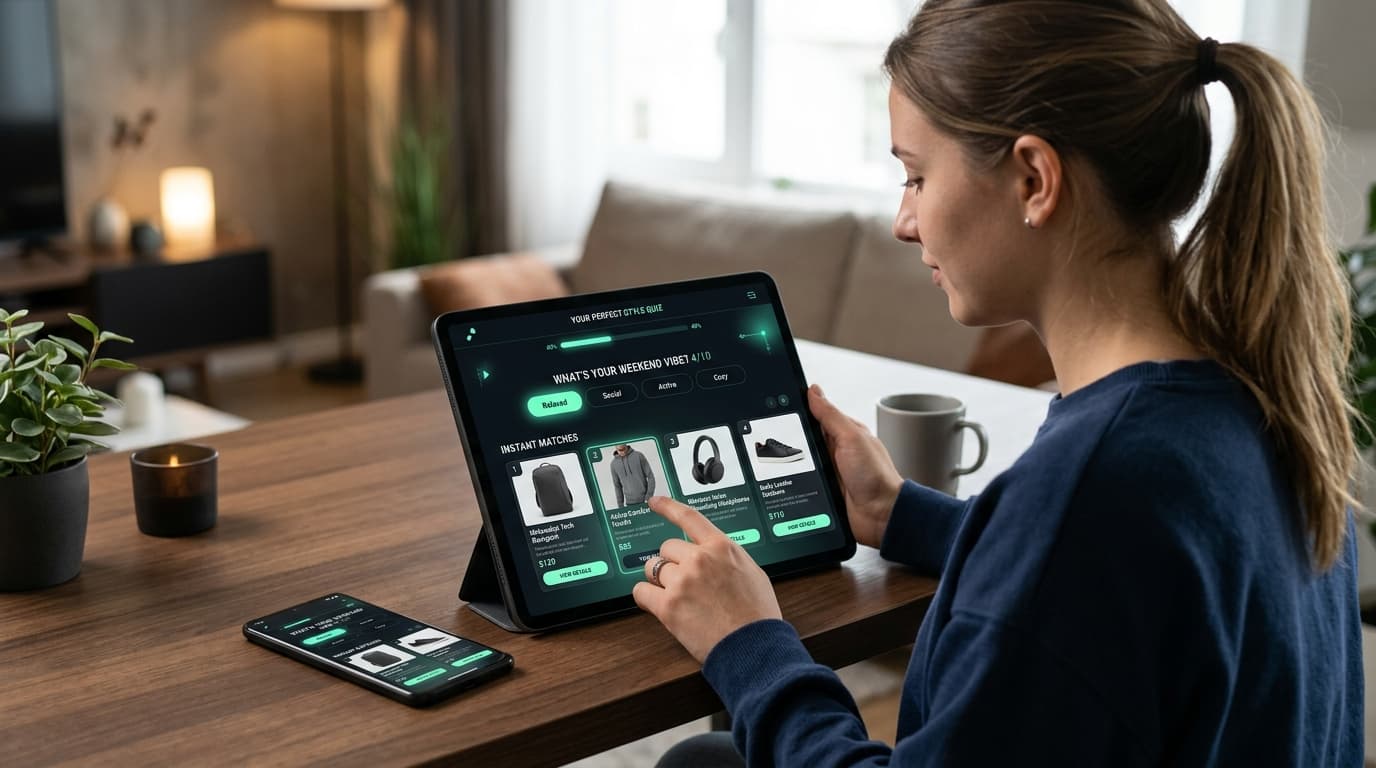
User arrives ➔ Sees visual prompt ➔ Taps 4 intuitive image cards (15-20s total) ➔ Instant 1-click tailored recommendations ➔ Low Friction ➔ High Conversion
On mobile smartphones—which represent over 70% of modern consumer traffic—tapping four curated visual cards takes under 20 seconds. Typing four complex conversational prompts into a chat widget can take several minutes and causes immediate drop-off.
---
Head-to-Head Architectural Comparison
Let us contrast the architectural, functional, and commercial realities of conversational AI chatbots against structured guided selling engines like GuidelyPro.AI:
| Feature Dimension | Conversational AI Chatbots (LLMs) | Structured Guided Selling (GuidelyPro.AI) | | :--- | :--- | :--- | | Primary Interaction Model | Free-form text input / chat prompts | Multi-step visual cards, tap buttons & sliders | | Mobile UX Usability | Poor (Requires mobile keyboard typing) | Exceptional (One-thumb tap ergonomics) | | Average Completion Time | 2 to 5 minutes | 30 to 45 seconds | | Risk of AI Hallucinations | High (May invent features, prices, or policies) | Zero (Deterministic data mapped to real SKUs) | | Real-Time Inventory Accuracy | Often delayed or approximated | 100% synchronized via live store webhooks | | Visual Product Merchandising | Clunky text links or basic cards in chat bubble | Full-fidelity product photography, badges & reviews | | Average Completion Rate | 12% to 22% of started chats | 65% to 85% of started quizzes | | Conversion Rate Lift | +15% to +35% on completed chats | +180% to +350% on quiz completers | | Zero-Party Lead Capture | Inconsistent (Asking for email in chat feels invasive) | High-converting (Dedicated pre-results lead screen) | | Implementation Complexity | High prompt engineering, RAG tuning, moderation | Low (Pre-built industry templates, zero-code) |
---
5 Fatal Flaws of Conversational AI Chatbots in E-Commerce
While conversational AI excels at post-purchase customer support (e.g., "Where is my tracking number?" or "What is your return policy?"), it suffers from five critical handicaps when applied to pre-purchase product discovery:
1. The Mobile Keyboard Tax
2. Generative Latency Kills Commercial Momentum
3. The Risk of Brand-Damaging Hallucinations
4. Chat Bubbles Conceal Visual Merchandising
5. Intrusive and Annoying User Experience
Experience the clean, high-converting power of GuidelyPro.AI on your storefront today.
---
The Behavioral Economics of Customer Decision Journeys
Why do customers convert more reliably when walking through a guided questionnaire than through open-ended conversations? The answer lies in behavioral economics and decision architecture:
1. The Commitment and Consistency Principle
2. Elimination of Unconscious Ignorance
3. Perceived Authority of Algorithmic Curations
---
When to Use Which: The Optimal E-Commerce Tech Stack
Does this mean online retailers should abandon chatbots entirely? Not at all. High-performing e-commerce brands use both tools—but they deploy them for the specific tasks where each naturally excels:
Pre-Purchase Discovery & Guided Selling:
➔ Deploy GuidelyPro.AI (Visual quiz, zero-party data, bundling, 3x conversion lift)

Post-Purchase Support & Policy Questions:
➔ Deploy AI Customer Support Bot (Tracking numbers, FAQ answers, warranty claims)
By separating pre-purchase product discovery from post-purchase customer support, you maximize conversion rates at the top of the funnel while minimizing support ticket overhead at the bottom.
---
Real-World Case Study: DTC Apparel Brand Switches from Chatbot to GuidelyPro
To observe the commercial impact of this transition, examine the actual testing results of a direct-to-consumer technical outdoor apparel merchant:
The Initial Setup (Conversational AI Chatbot)
The New Strategy (GuidelyPro.AI Guided Selling)
---
Why GuidelyPro Delivers Superior Merchant ROI
Beyond the end-user shopping experience, GuidelyPro.AI provides distinct advantages for the e-commerce marketing team managing the platform:
Deterministic Merchandising Control: Merchandisers can explicitly pin seasonal items, prioritize high-margin SKUs, or run clearance inventory through the recommendation engine without wrestling with complex AI system prompts. 2. Actionable Zero-Party Analytics: Every response is categorized into structured analytics data (e.g., "62% of our customers prioritize waterproof over breathability"), enabling merchandising teams to make data-driven buying and inventory forecasting decisions. 3. Seamless CRM Integration: Quiz tags and customer attributes synchronize cleanly into Klaviyo, Omnisend, and Mailchimp profiles, powering automated post-quiz email and SMS nurture flows. 4. Predictable Flat Pricing: Unlike enterprise conversational bots that charge per AI token or per conversation, GuidelyPro offers flat-rate monthly pricing with zero surprise charges.
---
Explore More E-Commerce Strategy on AfricaDeep
Deepen your understanding of digital merchandising and conversion optimization: - GuidelyPro.AI Complete Review: Features, Pros & Cons - How to Measure Guided Selling Conversions & Analytics - GuidelyPro for Large Product Catalogues: Taming Complexity - How to Evaluate an AI Product Finder: 10-Point Checklist - Explore GuidelyPro.AI in our AI Tools Directory
---
Frequently Asked Questions (FAQ)
Why do visual quizzes convert better than conversational chat widgets?
Can an AI chatbot hallucinate products or pricing?
How fast does a guided selling quiz load compared to an AI chat response?
Can GuidelyPro collect customer email addresses like a chatbot?
What happens when inventory runs out during a quiz?
Can I run GuidelyPro and a customer support chatbot on the same store?
Does setting up GuidelyPro require programming or prompt engineering?
What platforms does GuidelyPro support?
---
Conclusion: Choose the Right Tool for Revenue Generation
Conversational AI is a marvel of modern technology, but when it comes to guiding high-intent shoppers through a product catalog and closing digital sales, speed, visual clarity, and structured simplicity win every time.
By replacing clumsy chat widgets with intuitive, tap-friendly guided selling wizards, online retailers eliminate friction, delight mobile shoppers, and drive substantial conversion lifts.
Ready to upgrade your store's product discovery experience? Launch GuidelyPro.AI on your store today and see why structured guided selling is the future of e-commerce conversions.