From Soweto to Sandton: The Builders South Africa's AI Panel Cannot Afford to Ignore
AI governance in South Africa remains the domain of boardrooms and lecture halls. But the most consequential AI work on the continent is happening in township innovation hubs, co-working spaces, and open-source collectives that no policy panel has yet consulted.

Technology journalist and startup analyst tracking venture capital, entrepreneurial breakthroughs, and commercial machine learning scaling in Africa.
Published: 12 April 2026
Updated: 12 April 2026
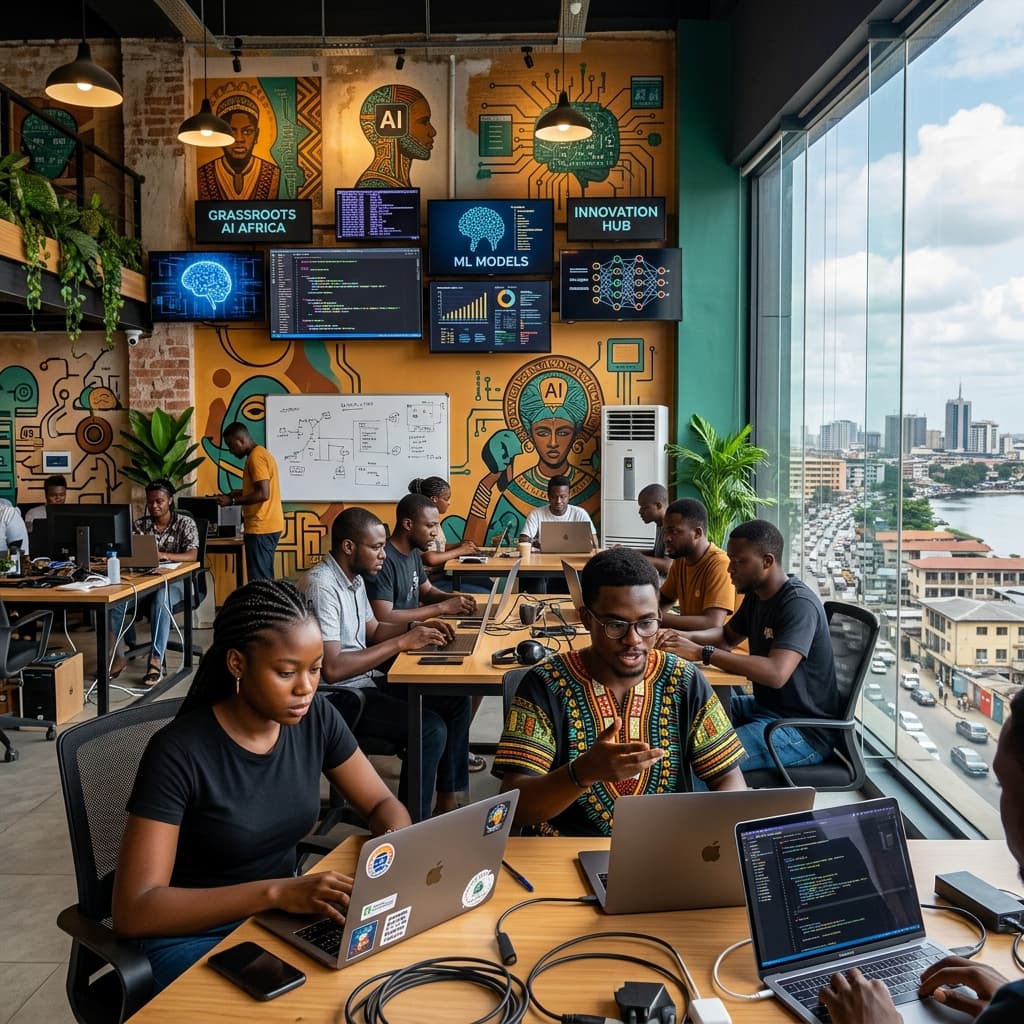
On a Saturday afternoon in Soweto, a group of eight young developers is gathered around a table in a community tech hub that operates out of a converted shipping container. The container has Wi-Fi — paid for by a local telecommunications sponsor — and a generator that kicks in when Eskom's load-shedding schedule cuts the grid power. The developers are building a WhatsApp-based chatbot that helps informal traders in Bara taxi rank manage their inventory using voice notes in isiZulu. The model that powers the chatbot's natural language understanding was fine-tuned on a dataset they assembled themselves: 12,000 transcribed voice messages donated by willing traders, cleaned and labelled over three months of volunteer work.
No one in this container has been invited to sit on South Africa's reconstituted AI policy panel. No one in this container has been asked to submit written comments on the draft AI framework. And yet, the work being done here — building AI systems for users who are invisible to the formal economy, in languages that global tech companies do not prioritise, on devices that Silicon Valley engineers would not recognise as viable deployment targets — represents the most consequential frontier of AI development on the African continent.
The Two South Africas of AI
South Africa's AI ecosystem operates in two parallel worlds that rarely intersect. The first is the world of corporate AI deployment: Discovery Health's risk models, Standard Bank's fraud detection systems, Vodacom's network optimisation algorithms. These systems process millions of transactions daily, employ hundreds of engineers, and are backed by billions of rands in infrastructure investment. The companies that operate them have compliance departments, ethics committees, and the resources to engage with any regulatory framework the government produces.
The second is the world of grassroots AI development: community tech hubs in township areas, university student projects that evolve into informal startups, open-source contributors building language tools for communities that commercial AI companies have decided are not profitable enough to serve. These developers are building for the 60% of South Africans who interact with technology primarily through mid-range smartphones, who communicate primarily in languages other than English, and whose needs are not represented in any corporate AI product roadmap.
The AI policy panel being assembled in Pretoria is drawn almost exclusively from the first world. Its members — distinguished academics and senior corporate technology officers — bring deep expertise in theoretical AI governance and enterprise deployment. But they bring very little direct experience of the conditions under which grassroots AI development occurs. They have not experienced the engineering constraints of building for devices with 2GB of RAM. They have not navigated the data sourcing challenges of assembling training corpora for languages with no Wikipedia presence. They have not faced the commercial reality of building a product for users whose average monthly mobile data expenditure is R50.
What Grassroots Builders Know
The developers in that Soweto container — and their counterparts in Khayelitsha, Alexandra, Mamelodi, and dozens of other township innovation spaces — possess knowledge that is critical to effective AI governance and that cannot be acquired through academic research or corporate experience.
They understand failure modes that enterprise systems never encounter. When an AI system is deployed on a device with intermittent connectivity, limited storage, and a battery that lasts four hours, it fails in ways that cloud-based enterprise systems never do. These failures — mid-inference crashes, corrupted model weights from interrupted downloads, input preprocessing errors caused by non-standard character encoding in African languages — are invisible to developers working in well-resourced environments but are daily realities for grassroots builders.
They understand user trust dynamics in marginalised communities. Building an AI system that works technically is one challenge. Getting users in marginalised communities to trust and adopt it is an entirely different challenge. Communities that have historically been subjects of data extraction — their data collected for research purposes without meaningful consent, their communities studied without benefit — approach new technology with justified scepticism. Grassroots builders who are embedded in these communities understand what trust-building looks like in practice: explaining the system in the user's language, demonstrating that data stays on the device, involving community leaders in the deployment process.
They understand the economics of serving low-income users. An AI product that charges R200 per month will never reach the users who need it most. Grassroots builders have developed creative business models — advertising-supported free tiers, pay-per-use microtransaction models via mobile money, community licensing arrangements where a single subscription serves an entire savings group — that reflect the economic realities of their users. These models require regulatory frameworks that are flexible enough to accommodate non-standard commercial arrangements.
The Cost of Exclusion
When grassroots builders are excluded from policy formulation, the resulting framework inevitably reflects the assumptions and priorities of the people who were in the room. Compliance requirements assume enterprise-level resources. Risk assessments assume cloud-based deployment architectures. Data governance standards assume formal corporate data management practices. The framework, in other words, is built for the South Africa of corporate headquarters in Sandton — not for the South Africa of innovation containers in Soweto.
The practical consequence is that grassroots AI development is pushed further into the informal sector. Builders who cannot comply with enterprise-oriented regulations do not stop building — they stop engaging with the regulatory system entirely. Their products continue to serve users, but without any oversight, quality assurance, or consumer protection framework. The regulation designed to protect citizens ends up protecting only those citizens who are already served by well-resourced corporate products.
Structural Solutions
Correcting this exclusion requires more than adding a token startup founder to an otherwise unchanged advisory panel. It requires structural changes to how AI policy is formulated in South Africa.
Decentralised consultation. Rather than expecting grassroots builders to submit written comments on draft policy documents — a format that assumes fluency in regulatory language and available time for policy analysis — conduct consultation sessions in the spaces where development happens. Visit the tech hubs in Soweto, Khayelitsha, and Mamelodi. Observe the work. Ask the builders what regulatory support would actually help them, and what requirements would shut them down.
Parallel advisory tracks. Establish a grassroots advisory council that operates alongside the main policy panel, with a formal mechanism for transmitting its recommendations. Give this council authority to flag regulatory proposals that would disproportionately burden small-scale developers, and require the main panel to respond to these flags on the record.
Compliance assistance. Rather than simply imposing compliance requirements and leaving small developers to figure out how to meet them, provide compliance toolkits, template documentation, and free advisory services specifically designed for developers working outside corporate structures. The cost of this assistance is trivial compared to the economic value of the grassroots AI ecosystem it protects.
The AI being built in township innovation spaces is not a side project. It is not a hobby. It is the front line of AI development for the majority of South Africa's population. A governance framework that ignores this work is a framework that governs only the minority — and in a democracy, that is a framework that has failed before it begins.